Static Semantics란
Static Semantics(정적 의미론)란 프로그램을 실행하지 않고도 검사할 수 있는 (=컴파일 타임에 확인되는) 의미적 규칙이다.
e.g. 변수의 선언 여부 확인, 변수의 타입 검사
Attribute Grammar란 속성(Attribute, 의미적 정보)를 구문 트리의 각 노드에 부여하고, 그 속성값을 계산하는 방법이다.
CFG 언어의 어떠한 특징들은 BNF로 표현하기 어려운 경우가 있다.
Attribute Grammar는 BNF만으로 표현하기 어려운 언어의 의미론적(semantic) 규칙을 보완한다.
- Attribute
- associated with grammar symbols
- 의미 정보 (변수의 타입, 선언 여부 등)
- Predicate Function
- boolean expression on attribute set and literal attribute values
Attribute 값이 유효한지 검사 - Predicate function value for nonterminal should be true
각 비터미널에 대해 정의된 Predicate 함수는 해당 구문 노드의 속상 값이 올바르게 계산되었음을 보장하기 위해 항상 true여야 함
- boolean expression on attribute set and literal attribute values
- Attribute Computation Functions
- associated with how attribute values are compute
- Attribute 값을 계산해서 상위/하위 노드에 전달
Synthesized/Inherited Attributes
속성(Attribute)는 Synthesized Attribute와 Inherited Attribute로 나눌 수 있다.
| 속성 종류 | 설명 | 방향 | 예시 |
|---|---|---|---|
| Synthesized Attribute (합성 속성) | 자식 노드 → 부모 노드 (자식 노드들의 정보 “합성”) | Bottom-up | 표현식의 결과 타입 계산 |
| Inherited Attribute (상속 속성) | 부모 노드 → 자식 노드 | Top-down | 변수의 기대 타입 전달 |
- A(X): 기호 X에 연결된 모든 속성들
- S(X): X의 합성 속성들
- I(X): X의 상속 속성들
아래와 같은 BNF에 대해
<stmt>     → <decl> | <assign>
<decl>     → type id
<assign>   → id = <expr>
<expr>     → id | number
아래는 Synthesized Attribute의 예시다.
<expr> → id
{ <expr>.type = lookup(id).type; }
<expr> → number
{ <expr>.type = "int"; }
<expr>.type이라는 Synthesized Attribute를 만들고, 이 속성은 부모 노드로 전달되어 사용된다.
아래는 Inherited Attribute의 예시이다.
<assign> → id = <expr>;
{ <expr>.expected_type = lookup(id).type; }
위에서 좌변 타입이 우변에 전달 된 후, <expr>.actual_type이 계산되어 비교될 것이다.
따라서 우변 <expr>이 어떤 타입이 되어야 할지를 부모가 알려주는 구조이다.
아래는 Predicate Function의 사용 예시이다.
<assign> → id = <expr>;
{ if (lookup(id).type ≠ <expr>.type)
    error("타입 불일치"); }
실제 코드로 보면
int x;
x = 123;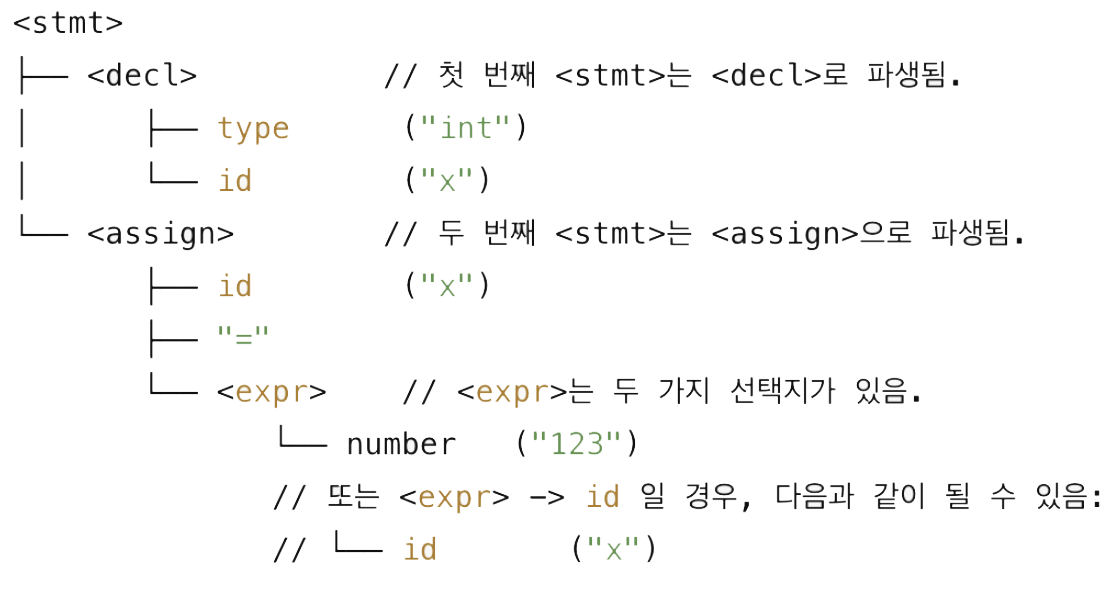
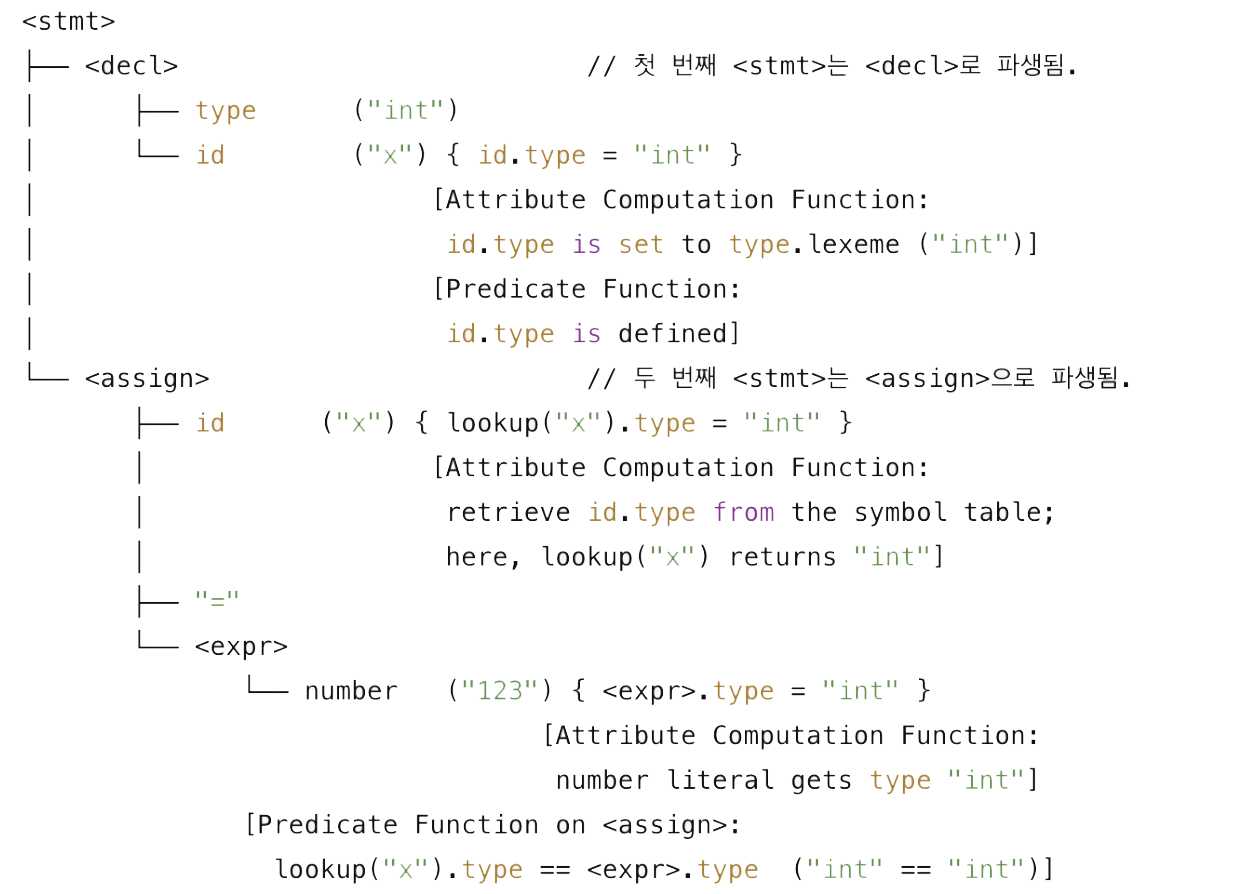
예시
Procedure 이름 일치 검사
Rule that name on the end should match with procedure’s name
<proc_def> → procedure <proc_name>[1] <proc_body> end <proc_name>[2];BNF로 알 수 있는 것들
- “procedure” 키워드로 시작하고,
- 첫 번째
<proc_name>[1](절차 이름)이 나오며,- 절차 본문
<proc_body>가 이어지고,- “end” 키워드 뒤에 두 번째
<proc_name>[2](절차 이름)가 나오며,- 마지막에 세미콜론(;)으로 끝남.
마지막에 나오는 <proc_name>[2]는 처음에 나온 <proc_name>[1]과 반드시 동일해야 함.
Predicate을 통해 <proc_name>이 동일한지 확인할 수 있다.
Predicate: <proc_name>[1].string == <proc_name>[2].string타입 규칙이 포함된 할당문 검사
How an attribute grammar can be used to check the type rules of a simple.
- 변수:
A,B,C - 타입:
int,real - 연산:
+,- - 규칙:
- 피연산자 타입이 같으면 그대로
- 다르면
real로 승격됨 (자동 형변환처럼)
<assign> → <var> = <expr>
<expr> → <var> + <var>
       | <var>
<var> → A | B | C
1. Syntax rule: <assign> → <var> = <expr>
Semantic rule: <expr>.expected_type ← <var>.actual_type
2. Syntax rule: <expr> → <var>[2] + <var>[3]
Semantic rule: <expr>.actual_type ←
if (<var>[2].actual_type = int)
and (<var>[3].actual_type = int)
then int else real end if
Predicate: <expr>.actual_type == <expr>.expected_type
3. Syntax rule: <expr> → <var>
Semantic rule: <expr>.actual_type ← <var>.actual_type
Predicate: <expr>.actual_type == <expr>.expected_type
4. Syntax rule: <var> → A | B | C
Semantic rule: <var>.actual_type ← look-up(<var>.string)The look-up function looks up a given variable name in the symbol table and returns the variable’s type.